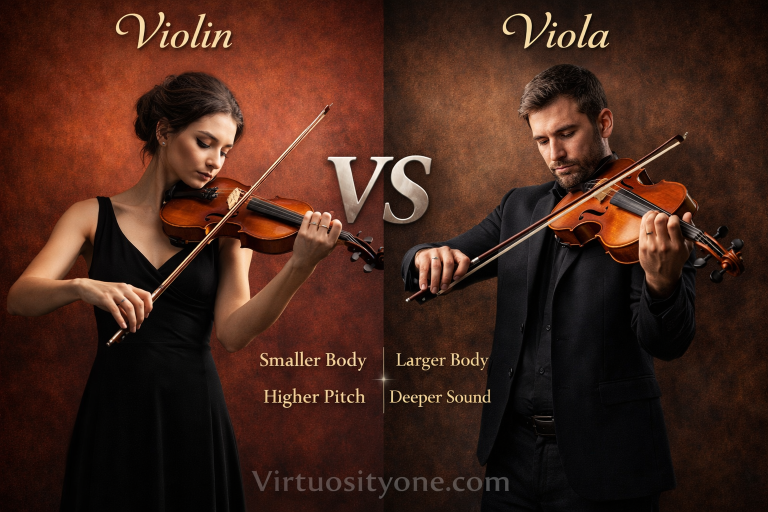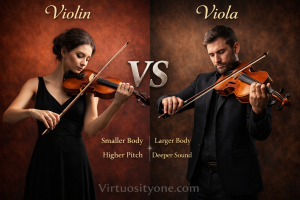
Most people searching violin vs viola are not looking for a diagram of the instruments or a list of physical differences. They already know the viola is bigger, lower, and played in a different clef. What they are actually weighing — and often uncomfortable saying directly — is something more specific: whether it makes sense to switch, and whether doing so for practical reasons rather than purely musical ones is a legitimate choice.
That is the question this article addresses. The differences are covered, but the decision — the real one — is what this is actually for.
The Violin vs Viola Decision Nobody Talks About Honestly
Here is the thing the forums know but the articles rarely say: a significant number of violinists who consider the viola are thinking about it because viola players are in chronic short supply. Orchestras — youth, amateur, semi-professional, professional — almost always need more violists than they can find. The violin sections are full. The viola section has empty chairs. A competent violinist who makes the switch can often walk into ensemble opportunities that would take years to compete for on violin.
If that is part of your thinking, it is a completely legitimate reason. It does not mean you are abandoning the violin or settling for less. It means you are being honest about what you want from your playing — and matching your instrument to that goal.
What Actually Changes: Violin vs Viola
The technique transfers more directly than most players expect. The bow hold is the same. The left hand technique is the same. The muscle memory you have built on violin does not disappear when you pick up a viola — it relocates onto a slightly larger instrument with wider string spacing and thicker strings that require a little more bow weight to set into motion.
The two genuine challenges are physical and notational.
Physically, the viola is larger — typically 15 to 17 inches for an adult, compared to 14 inches for a full-size violin. Over a long rehearsal, the extra weight and the wider reach between notes makes demands on the shoulder, neck, and left hand that violin players have not trained for. This is not insurmountable, but it is real, and players with smaller hands or frames should try multiple sizes of viola before committing to one.
Notationally, the viola uses the alto clef — a C clef that sits the middle line of the staff on middle C. It is used by almost no other instrument, which means violinists switching to viola face a genuine re-learning process. Most players report that it takes several months of regular reading before the alto clef becomes instinctive. Until then, the mental overhead of translating notes is a constant low-level friction that slows down everything else.
The Sound: What You Gain and What You Give Up
The violin’s E string is one of the most expressive and penetrating sounds in all of chamber and orchestral music. If you have spent years developing your tone on that string, giving it up is a real sacrifice — not a small one.
What the viola gives you in return is the C string, and players who have crossed from violin to viola consistently describe it as one of the most unexpected revelations in string playing. The resonance of the C string vibrating against your throat and collarbone is a physical sensation that violin simply cannot replicate. Players who have made the switch often describe picking up their violin afterward and finding it too bright, too small, somehow incomplete.
Neither of those responses is wrong. They are describing genuinely different instruments with genuinely different musical personalities. The violin is brilliant, agile, and exposed — it carries melody because it is built to be heard. The viola is warmer, darker, and more inward — it carries harmony because its voice suits the inner texture of ensemble music. Choosing between them is partly a question of which musical role you want to inhabit.
The Practical Reality of Violin vs Viola
For a player who wants to perform in ensembles and orchestras, the viola offers a shorter path to the chair. This is simply a supply and demand reality, not a reflection on the difficulty or value of the instrument. In fact, the viola section of a smaller orchestra offers something the violin sections rarely do: you are heard individually. There is nowhere to hide in a section of four viola players. The standard of playing required is no lower, and the exposure is often higher.
Solo repertoire is thinner on viola — that is honestly true. The great violin concertos vastly outnumber their viola equivalents, and if performing as a soloist is your goal, the violin is the more practical instrument. But for a player whose joy is ensemble playing, chamber music, and being part of a sound rather than above it, the viola is not a consolation. It is the right instrument.
If You Are a Violinist Considering the Switch
Borrow a viola before you buy one. Play it for a month, with a teacher who knows both instruments, and give the alto clef the same dedicated attention you would give a new piece. The physical adjustment takes weeks, not days — the clef takes longer. If after a month you still want to continue, you have your answer.
Most players who make the switch report that it took longer than expected to feel fluent, and that they are glad they did it. What they rarely report is regret about the decision itself. The violin vs viola question, once lived rather than theorised, tends to answer itself.
If You Are Choosing for the First Time
Listen to both instruments played well before you decide anything. Not recordings — live, in person, close enough to feel the sound. The violin from the front and the viola from beside the player are two different experiences. The viola’s lower frequencies travel differently and land differently, and no amount of reading about the sound can substitute for hearing it in the room.
If you are drawn to the lower, richer sound — if the viola’s voice resonates with something in how you hear music — follow that. The practical realities of supply and demand will work in your favour. If you are drawn to the brightness, the repertoire, and the prominence of the violin, follow that too. There is no wrong answer in the violin vs viola decision. There is only the instrument that suits what you actually want from playing, and the one that does not.
For a thorough overview of both instruments from a technical and acoustic standpoint, Strings Magazine remains the most authoritative English-language resource for bowed string players at every level.