You have already read the advice. Start acoustic. Learn the basics. Switch later. Every teacher, every forum, every article about electric violin for beginners eventually lands on the same sentence — and then offers you a list of acoustic violins. But here you still are, searching for an honest take on the electric path, which suggests you have a specific reason the standard advice does not quite fit your situation. You deserve a direct answer to that specific situation, not a redirect.
Here it is.
Why Most Advice Says Acoustic — and When That Advice Is Right
The acoustic-first recommendation comes from a real technical concern, not tradition for its own sake. An acoustic violin is essentially a feedback device. Every imperfection in your bow technique — too much pressure, too little, the wrong contact point — is immediately audible in the tone the instrument produces. That feedback is how you learn. The natural resonance of the wooden body tells you things a pickup and amplifier cannot replicate with the same immediacy or accuracy.
On a solid-body electric violin, the pickup captures what the string does but compresses the tonal range and softens the consequences of poor bow technique. You can develop habits on an electric that an acoustic would have corrected weeks earlier. For this reason, if you plan to play classical repertoire, sit in an orchestra, or work with a traditional teacher, starting acoustic is the right call and the advice should be followed without question.
When an Electric Violin for Beginners Actually Makes Sense
The problem with the blanket acoustic recommendation is that it assumes every beginner has the same situation. They do not. Here are the circumstances where choosing an electric violin for beginners is not just defensible — it is the more practical decision.
You live in an apartment and cannot practice freely on an acoustic
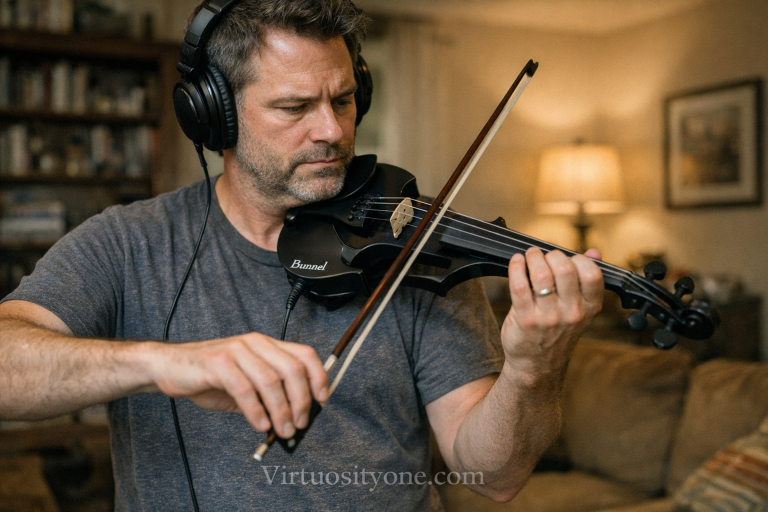
This is the most common and most legitimate reason. A beginner who cannot practice consistently because of noise anxiety, neighbor complaints, or building rules will not progress. An electric violin with a headphone output removes the constraint entirely. Consistent daily practice on an electric will advance a beginner further than intermittent, anxious practice on an acoustic. The technique transfer, when the player eventually moves to acoustic, is real and documented. The fundamentals — bow hold, finger placement, shifting — carry across. What adjusts is tonal sensitivity, and that adjustment happens quickly for a player who has developed good habits.
You want to play modern genres, not classical
If your goal is rock, pop, folk fusion, or experimental music, the acoustic feedback argument weakens significantly. The tonal nuances that classical technique develops on an acoustic are not the primary skill set you need. An electric violin for beginners in this context is as valid a starting point as an electric guitar is for a beginner who has no interest in classical guitar. The instrument matches the music you are trying to make.
You are an adult returning to violin after a break
Players who studied acoustic violin earlier in life and are returning retain muscle memory, ear training, and bow awareness that a complete beginner does not have. For them, an electric is a practical tool, not a pedagogical compromise. The feedback concern largely does not apply.
The Electric Violins Worth Considering as a Beginner
Not all electric violins for beginners are equal, and the gap between a $150 instrument and a $500 one is not cosmetic. Cheap electric violins produce unwanted background noise through the pickup, have uneven string response, and often have setup issues that make learning harder rather than easier. The instruments below represent honest starting points at different budgets.
Yamaha YEV-104 — Around $500
The clearest recommendation for a beginner who wants a reliable, well-built electric violin from a manufacturer with a long track record in this space. The Möbius-strip frame is visually distinctive, the all-wood construction produces a warmer tone than plastic-body alternatives, and the build quality is consistent. It does not include a headphone output — it is designed for performance rather than silent practice — so factor in an amplifier if you plan to play amplified. If silent practice is the primary need, pair it with a small headphone preamp.
Yamaha YSV104 Silent Violin — Around $600–$800
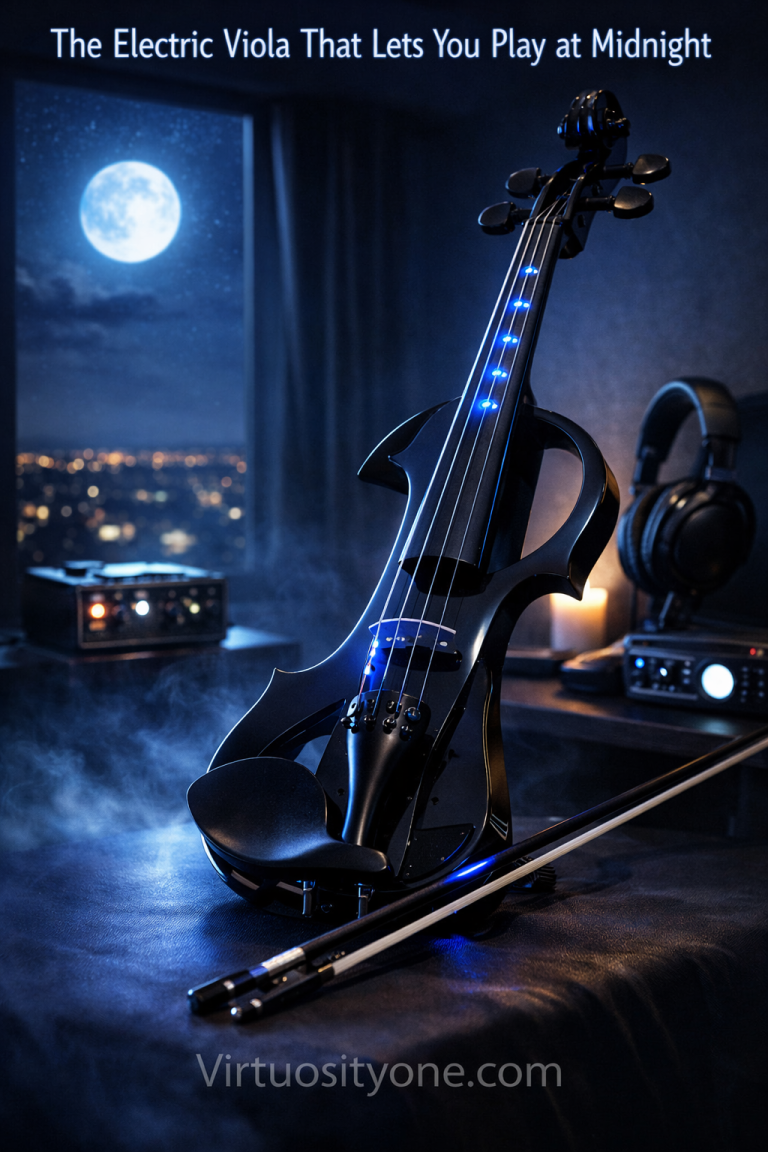
For the beginner whose primary need is practicing in silence, the YSV104 is the cleaner answer. Built-in headphone output, reverb control, and auxiliary input for playing along to recordings. This is the instrument Yamaha designed specifically for the apartment situation — it was created because in Japan, everybody lives ten feet from someone else. The design brief has not changed and the instrument answers it directly.
NS Design WAV — Around $700–$900
A more advanced option for the beginner who wants to invest once rather than upgrade quickly. The hollowed wooden body gives it a richer, more natural tone than solid-body alternatives, and the playability is well-regarded by both beginners and experienced players. Requires an external headphone amp for silent practice, which is an additional cost to factor in.
Entry-level options under $300
Complete outfits under $300 exist and function as an entry point. The pickup quality is noticeably lower, background noise is common, and the instruments often require setup adjustment before they play comfortably. If the goal is to test whether the electric path suits you before committing financially, an entry-level instrument removes the risk. If you already know you are committed, the Yamaha YEV-104 is a better starting investment — it will not hold you back the way a budget instrument will.
What You Will Need Besides the Violin
An electric violin requires more than the instrument itself. Here is what to budget for from the start.
An amplifier or headphone solution. For silent practice, a headphone output on the instrument or a small battery-powered headphone preamp handles everything. For performance, use a dedicated acoustic instrument amplifier — not a guitar amp. Guitar amplifiers are voiced for magnetic pickups; electric violins use piezo pickups that require different impedance and frequency response. Running a violin through a guitar amp produces a shrill, hollow result. Sweetwater’s acoustic amplifier guide covers the options across all price points clearly.
A bow. Some outfits include one. If not, budget $50–$100 for a decent student bow. The bow matters more than most beginners expect — a poor bow makes learning harder at every stage.
Rosin. Every bowed string instrument requires rosin on the bow hair to engage the strings. It is inexpensive and non-negotiable.
A shoulder rest. Most electric violins accept standard acoustic shoulder rests. Check before buying — a few models have proprietary designs that limit your options.
The One Question That Settles It
Before buying anything, answer this honestly: why do you want an electric violin for beginners rather than acoustic? If the answer is noise and apartment constraints, an electric is the right call and the Yamaha YSV104 is the direct answer. If the answer is genre — you want to play music that acoustic violin cannot serve — an electric is the right call and the YEV-104 is the starting point. If the answer is that you simply find the electric more exciting and motivating, that matters too. Motivation drives consistency, and consistency is what actually produces progress at the beginning.
If the answer is that you assumed electric might be easier to learn on — it is not, and acoustic is the better starting instrument for that goal.
The debate between acoustic and electric for beginners is real but overstated. Both paths produce violinists. The question is which path fits your actual life — your living situation, your musical goals, and the hours you can realistically dedicate to practice. Answer that honestly, and the right instrument becomes obvious.