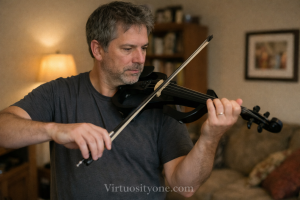
You already know about the mute. You probably own one. You clip it to the bridge, the volume drops, and you feel like you have solved the problem of living in a building with other people. But something is wrong, and you have noticed it. The instrument feels different. The bow does not respond the same way. The tone you have been working toward — the thing your teacher keeps pointing at — is impossible to hear or feel through the deadened strings.
The mute is not just quieter. It is a different instrument. And the practice you are doing on it is not quite the same as the practice you need. A silent electric violin is the answer most players eventually land on — and the one nobody recommends early enough.
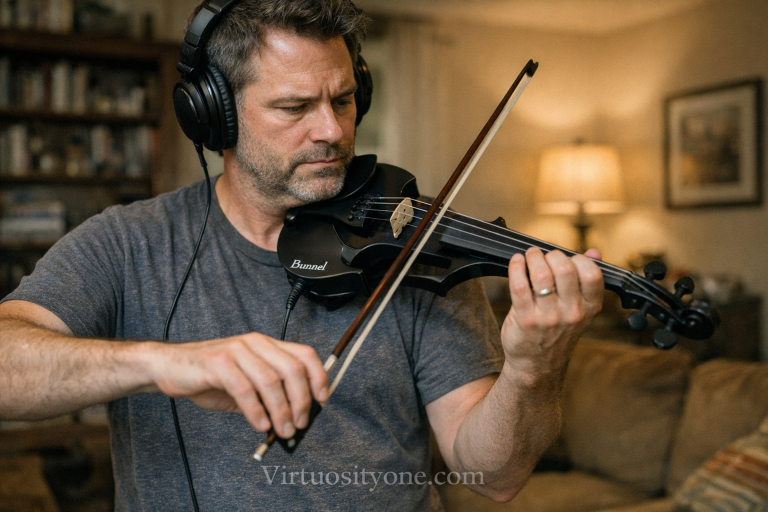
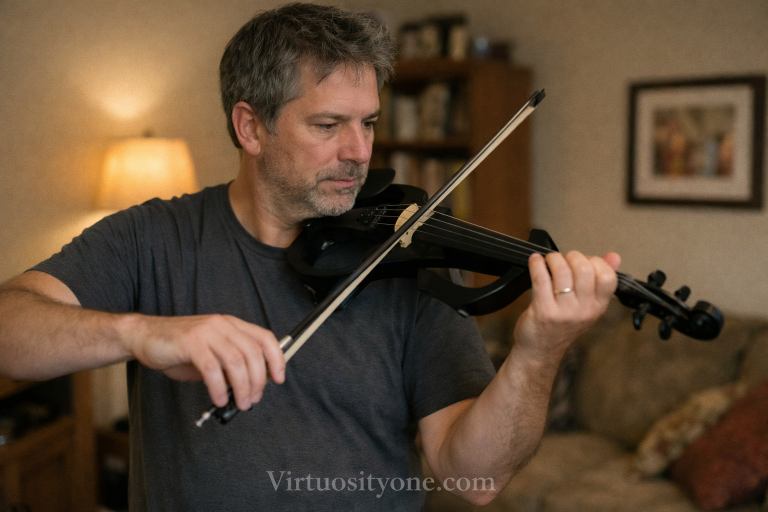
A silent electric violin solves something a mute cannot: it lets you practice the actual violin — your bow pressure, your tone production, your intonation, your response to the string — through headphones, at any hour, without the neighbors ever knowing you are playing.
What the Mute Cannot Do
This is the part nobody talks about honestly. A practice mute works by squeezing the bridge, which dampens the vibration that creates sound. The side effect is that it also dampens the feedback the instrument gives you. The subtleties of how the bow engages the string — the thing you are actually trying to develop — are dulled or removed entirely. Players who use mutes consistently report the same experience: they sound better with the mute on, because the mute is hiding what they need to fix.
One player, preparing for an orchestral audition and practicing under a neighbor’s noise complaints, described it directly: the mute made it impossible to work on tone production. They were at a stage in their playing where they needed to hear and feel the instrument clearly. The mute made serious practice impossible precisely when serious practice mattered most.
A silent electric violin does not compress the bridge. The string vibrates naturally. The bow engages the string the way it always does. What changes is only where the sound goes — into headphones, not into the building.
How a Silent Electric Violin Actually Works
Without amplification, a solid-body electric violin produces a faint ghost of sound — audible to you in a quiet room, but not through a wall. It is comparable to a heavily muted acoustic, but without any of the mechanical compromise to playability. With headphones connected, even that ghost disappears. You hear the full sound of the instrument, including the reverb and resonance you choose to dial in, while producing nothing the person next door will ever detect.
The Yamaha engineer who helped develop the original Silent Violin in the late 1990s described the design brief simply: in Japan, everybody lives ten feet from someone else. That is still the problem. The instrument was built to solve it without asking the player to give anything up technically.
The Instruments Worth Knowing
Yamaha YSV104. The clearest answer for the player whose primary need is silent practice. Lightweight — roughly the same as an acoustic violin — with a built-in headphone output, adjustable reverb on the control box, and an auxiliary input so you can play along to recordings through the same headphones. It does not have a standard quarter-inch output, which means it is designed for practice, not performance. For the player who simply wants to practice freely every day, this is the instrument. Typically under $800, often found closer to $600.
Yamaha SV-200. For players who want silent practice and the option to perform amplified. It adds a standard quarter-inch output, a dual-piezo pickup for more balanced tone, and a removable chin rest that accepts standard accessories — a significant improvement in comfort over earlier models. The SV-200 sits in the $1,200–$1,500 range and is the instrument serious players choose when they want one electric violin to serve multiple purposes.
Yamaha SV-250. The professional version. Dual pickups with blend control, two-band EQ, XLR output, and a hollow chamber that gives it a tonal warmth the solid-body models cannot match. Players who have compared it to acoustic violins note the similarity is striking. Starting around $1,500. For musicians who want a silent practice instrument that doubles as a credible performance instrument, this is the ceiling worth aspiring to.
NS Design WAV. The alternative to Yamaha for players who prioritise natural tone above everything else. The hollowed wooden body gives it a richer, more acoustic character through amplification. It is slightly heavier than the Yamaha models and requires an external headphone amp rather than having one built in — an additional purchase to factor into the budget. Players who have used both describe the NS Design as sounding more like a wooden instrument; the Yamaha as more controlled and consistent. Neither is wrong. They suit different priorities.
Entry-level options. Instruments under $300 exist and function as a silent electric violin for basic practice. They will be quieter than your acoustic violin and will accept headphones. What they will not give you is the responsive, accurate pickup quality that makes the practice feel as close to acoustic playing as possible. For a player testing whether the electric path suits them, an entry-level instrument removes the financial risk. For a player who is serious about the practice quality, the Yamaha YSV104 is the minimum worth spending toward.
The One Thing to Know Before You Buy
Are you buying this to practice in silence, or do you also need to perform amplified? The answer matters because it points toward different instruments. The YSV104 is purpose-built for practice and has no standard amplifier output. The SV-200 and SV-250 do both. The NS Design WAV is optimised for performance tone and requires more setup for silent practice.
Most players searching for a silent electric violin are solving the practice problem first. If that is you, the YSV104 is the direct answer, and everything above it is a bonus you may or may not need.
On the Amplifier Question
For silent practice, you do not need an amplifier. The headphone output on the instrument handles everything. If you eventually want to perform or record, a dedicated acoustic instrument amplifier — not a guitar amp — is the right tool. Guitar amplifiers are voiced for magnetic pickups; electric violins use piezo pickups, which require different impedance and frequency response. Running a violin through a guitar amp produces a result that is shrill and unpleasant. AER and Fishman make amplifiers specifically suited to the task. Sweetwater’s acoustic instrument amplifier guide is a reliable reference for understanding the options before spending.
The Honest Trade-Off
A silent electric violin is not an acoustic violin. The technique transfers directly — the bow hold, the finger placement, the shifting — but the feel of the instrument under the chin is different, and the tonal feedback through your body changes. Most players adapt in days rather than weeks. What they consistently report afterward is not that the electric is better, but that they practice more. The overhead disappears. There is no calculation about the hour or the neighbor’s schedule. The practice happens when the playing is ready, not when the building permits it.
The mute will still have its place — for early morning passages when you want a second layer of quiet, or for playing in a hotel room the night before a performance. But the mute was never meant to carry the weight of daily serious practice. The silent electric violin was built for exactly that. Twenty-five years of development since the original Yamaha SV-100 have made it one of the most practical instruments a working violinist can own — not because it sounds better, but because it removes the one thing that was getting in the way of actually playing.